
How to bring about a permanent and modified change in behaviour for the good of all has been a vexing issue all across the world. Agriculture input companies constantly worry about farmers not adhering to safety protocols. Financial incentives have proven to be of little consequence in behaviour modification. Rural youth join vocational courses not out of great love for learning but for having free breakfast and lunches. The government of India has been spending millions of rupees in grants to attract, motivate and provide jobs to the youth. The results are so dismal that the government was forced to change the definition of ‘placed’ to ‘placed in jobs’, ‘upskilled’, and ‘self-employed’.
One possible reason for people resorting to old ways of behaviour is of course the fear of the unknown and comfort with the status quo. However, the latest research and trends in Behaviour Economics have proven to be effective in subtly changing the behaviour in desired direction for the greater good of all. Manipulation is a dirty word but that seems to be one effective way of nudging the behaviour. I firmly believe that the broad policy objectives of various stakeholders in the society like the government, educationists, and input companies can be realised by offering carefully chosen ‘nudges’ that subtly guide individuals to a set of desired courses. The excessive use of grants, financial incentives and packages has proved to be of little use.
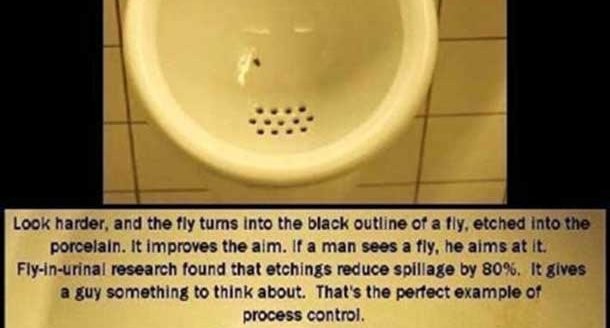
The folks at the Amsterdam airport had a problem in their hand to keep the airport toilets clean. Often men using the toilets made the floor dirty by peeing all over the place. Not aiming in the right direction was the probable cause. What was the solution? One obvious and direct approach would be to post a message asking men to keep the washroom clean. But what they did was something unusual. They etched a picture of a fly in the urinal and surprise of surprises men started aiming at the fly and no more the floor was dirty. The cleaning bill went down by 80%. This is a classic “nudge” theory in real-life application. Behaviour modification happens when men have something to ‘aim at’ and in this case, it happens to be the fly. The principle of nudging has its root in Behavioural Economics and it has great relevance to the system of delivering vocational education as it is practiced all over. Instead of a direct message- which is often the way education is delivered if we nudge the youth in an indirect manner it is more likely to be internalized. The principle underlying the way we act and behave depends on what is now known as the dual thought process theory. We normally operate from two mindsets. The first one is fast, automatic and emotional almost like a reflex action and the second one is slow, deliberate and logical. A writer has compared the first to the famous bumbling Homer Simpson and the second one to the equally famous Spock of Star Trek. Now the point here is that we meet more Simpsons in the world than the Spocks. And that means that our strategy for modifying the behaviour pattern has to take into account nudging than direct coaching. It is all revolving around the choice of architecture. Our training is often very direct and forced. Can we make it indirect and with a gentle nudge? Let me give more everyday examples to stress this point. In India, we have this tendency of throwing garbage outside the house. The assumption is that if it is outside my house I am ok. One approach would be to levy fine on littering and posting messages that littering is prohibited. Now if we supply the garbage bag with the name of the house owner written on it what would happen? I am sure suddenly people would become responsible and take the bag to the bin. The second example would be of eating more than necessary. If people are not conscious of how much they are eating if we replace the big plate with a smaller one automatically they would eat less. The third example would be of a small child that messes up their room with all the playthings spread all over. One direct way would be to reprimand the child and ‘order’ him to tidy his room. We all know that this will be met with stiff resistance or a cry. Instead, if we play the tidy game with the child am sure he will enjoy and actively participate in cleaning the room. The Montessori system has understood this principle very well.
But then I am digressing. The aim of this note is to highlight how gentle nudges could facilitate a change in the way we behave. Coming back to the example of agri-input companies it is usually observed that these companies having spent millions of dollars in research and development want the safety protocols to be very stringently and carefully followed by the farmers. They supply all the relevant technical literature to the farmers and have extensive field demos. But the reality is as soon as the demo is over the farmer resorts to his old ways of handling dangerous pesticides with bare hands and we have observed in Senegal that he often washes the coated seeds in river streams endangering the lives of many. So, the moot question is how can we prevent them to adhere to the safety protocols? To solve this vexed problem, we have developed a nudge-based push strategy that is aimed at, not the farmer, but his immediate family members. The messages in the form of SMS are directed to the children and the wives with loaded messages about their well- including financial stability depending on the health of the breadwinner. If he has to be healthy he has to adhere to certain safety precautions. This works as the nudge from the immediate family and children force the farmer to adopt safe handling practices. This is a behavioural intervention that helps subtly in the behaviour modification of the farmer. The key dimension of this behaviour modification strategy is to change the farmer’s behaviour in a predictable way without obstructing any other options including the prevailing economic incentives. To put it differently, what we are doing is a change in the ‘choice architecture’ by changing his default option. Let me elaborate on this with another simple example. In a multi-storey building with a lift, the default option would be to stand in a queue and wait for one turn to get into the lift. Now if we put a photo of an old and sickly-looking man at the door of the lift and another photo of a healthy and athletic man near the staircase with a suitable nudge message what would happen? People would prefer to climb than get into the lift. What we have done is subtly alter their default option. A very interesting case study of using a cost-effective nudge was carried out by the White House Social and Behavioural Science Team(SBST) in collaboration with the US Department of Defence (DoD). The experiment was aimed at increasing savings for the defence personnel towards their retirement plan. In the experiment around 806,801 military service members who were not contributing to the plan received an e-mail nudging them to contribute. A control group did not receive any e-mail. The results proved that there was a significant increase in the membership to opt for the plan which received the email that the control group. The point here is that if an email can be a useful nudge then through mobile push we can really bring about desired changes in different segments of society. It is high time that policymakers, educationists, agriculture input companies and other stakeholders in society understand the implications of behaviour economics principles and apply them in the respective domains. Surely if the aim is right on the fly then 80 % spillage in terms of wastage of money and other resources can be saved!!!!
